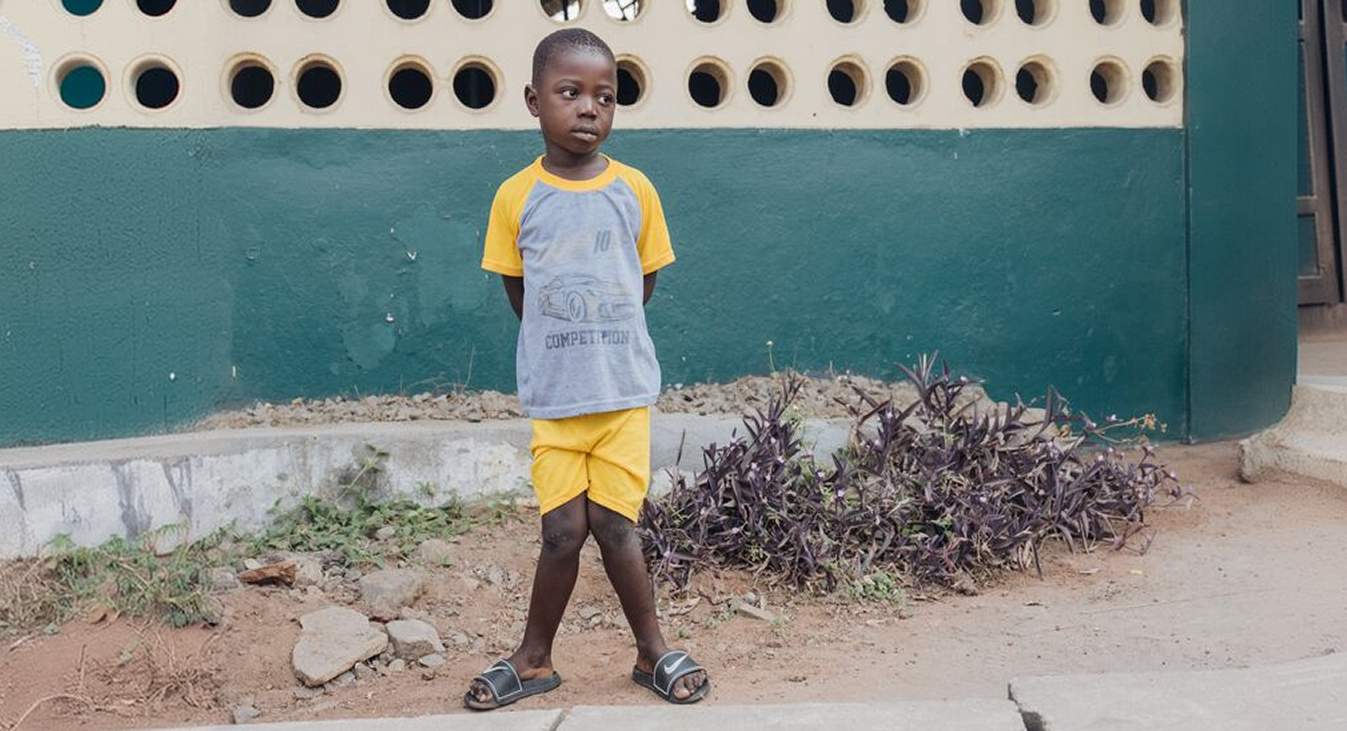
Amara lives in Nyawa, a remote village several hours from Sierra Leone’s capital of Freetown. Like many communities in the region, Nyawa is made up of close-knit families, most of whom farm cassava and rice for a living. But access to specialized healthcare, including surgical services, is scarce.
From an early age, it was clear that something was different about Amara. He was born with a condition called Genu Valgum, commonly known as “knock-knee.” As he grew, his legs curved inward, making it difficult to walk straight, stand upright, or enjoy simple childhood pleasures like kicking a ball.
“Children made fun of him,” his mother Betty shared. “They called him names like ‘the boy with legs tied together.’” The constant bullying took a toll on Amara, leaving him isolated and introverted. He stopped playing outside, and even before he was old enough to attend school, he didn’t want to go. Though he loved being around others, Betty said, “It never ends well,” describing how making friends was often short-lived for him.
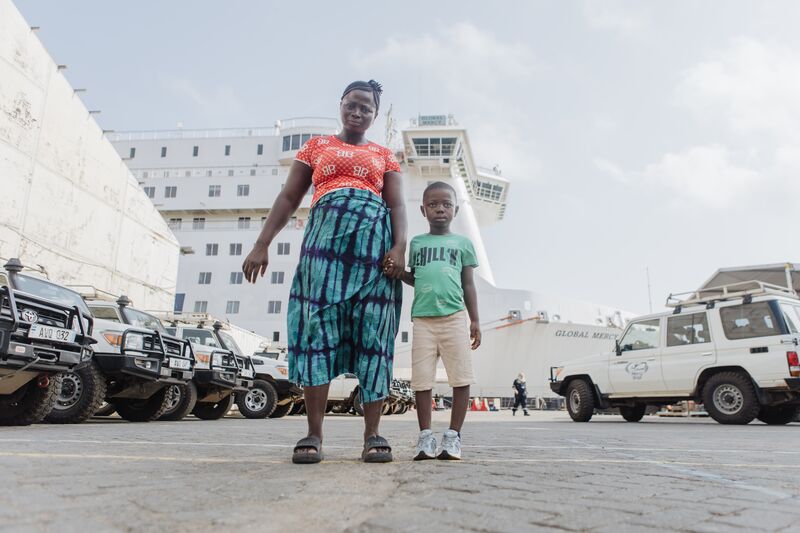
In rural Sierra Leone, healthcare is hard to come by. Many families depend on subsistence farming, which leaves little room—financially or logistically—for medical treatment. Amara’s parents worked tirelessly tending to their potato, cassava, and rice fields. But no amount of hard work could help them straighten their son’s legs.
Then one day, a neighbor told Betty about Mercy Ships, where a hospital ship called the Global Mercy™ was docked in Freetown offering free surgeries. Desperate for a solution, Betty made the journey to a nearby town with Amara to register him for care.
A Delicate Balance of Risk Versus Reward
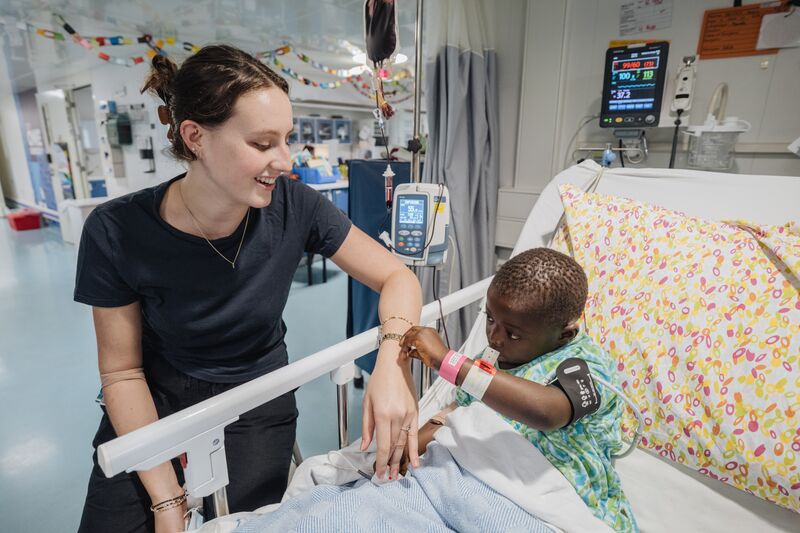
Once on board the Global Mercy, Amara’s case drew immediate attention. While many patients undergo complex orthopedic procedures, doctors found that Amara had an additional challenge that would make his surgery even more delicate.
As part of routine hospital protocol, every patient receives a full medical screening including blood tests. Through this, the team learned that Amara had Sickle Cell Disease (SCD).
SCD is a genetic blood disorder. Unlike healthy red blood cells that are round and flexible, cells with SCD are crescent-shaped and rigid. They can’t flow easily through blood vessels, making it hard to carry oxygen efficiently throughout the body. Worse still, these misshapen cells can clump together, triggering blockages that lead to pain, organ damage, and life-threatening complications known as sickle cell crises.
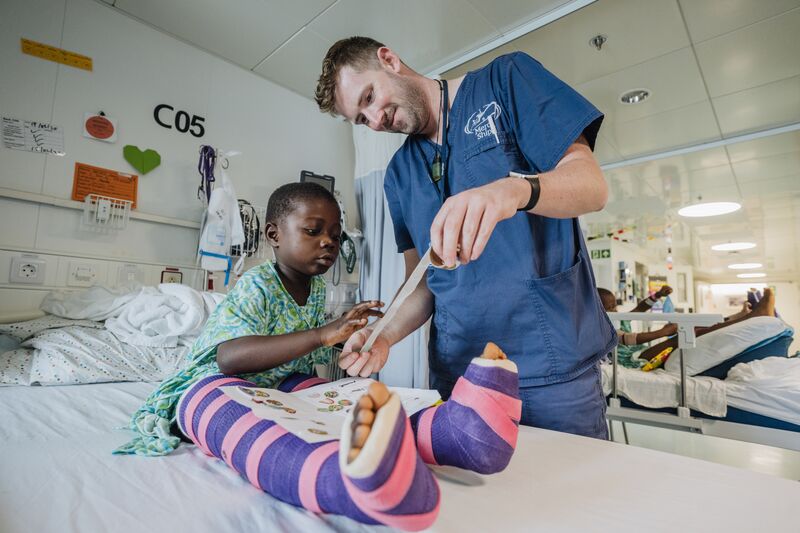
“Surgery poses a major risk to patients with SCD,” explained Dr. Belén Carsi, a volunteer pediatric orthopedic surgeon from Spain. “Any stress—physical or emotional—can trigger a crisis. That includes blood loss, low oxygen, and even changes in temperature during surgery.”
Amara’s surgery would require careful, manual control of blood flow and an exceptional level of precision.
To prepare for the operation, the team needed a specific blood type — O positive. It wasn’t guaranteed they’d find a match. But on a hospital ship full of international volunteers, it was worth a shot to find out.
A breakthrough came midway through Amara’s journey to healing. A Swiss volunteer named Alina had the exact blood type he needed. Without hesitation, she agreed to donate, and her blood was collected and sent to the lab for analysis.
“The lab has two big jobs,” said Auxanne, a volunteer medical lab technologist. “We do blood analysis to ensure a patient is ready for surgery, and we collect blood from crew volunteers when needed.”
The unit donated by Alina was thoroughly tested and prepared for when Amara was ready for operation.
With everything in place, Dr. Carsi and her team moved forward. Due to the heightened risks associated with Amara’s condition, the operation took longer than usual. They could only correct one leg at a time, pausing between procedures to check Amara’s hemoglobin levels and confirm that his body was coping well with the stress.
Because of the sickle cell factor, the surgery was “tricky,” Dr. Carsi admitted. “But his legs are now beautifully straight. He’s coped well, with no signs of crisis.”
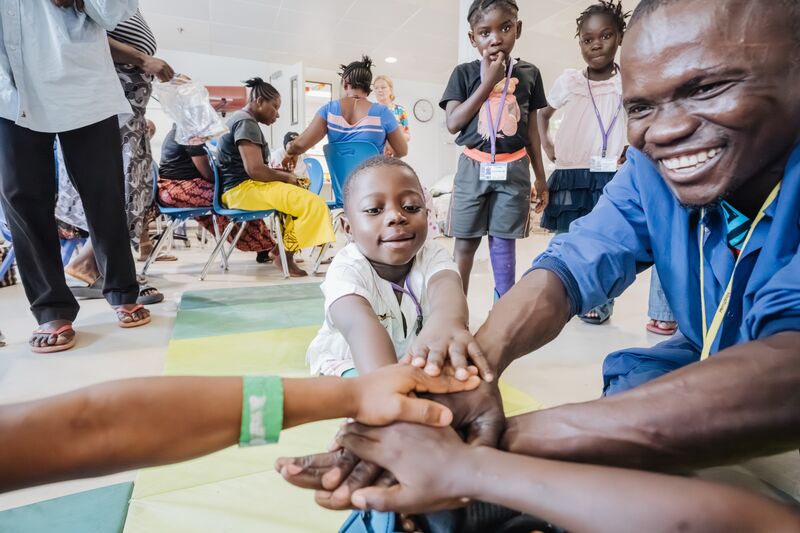
Relearning Joy on the Road To Recovery
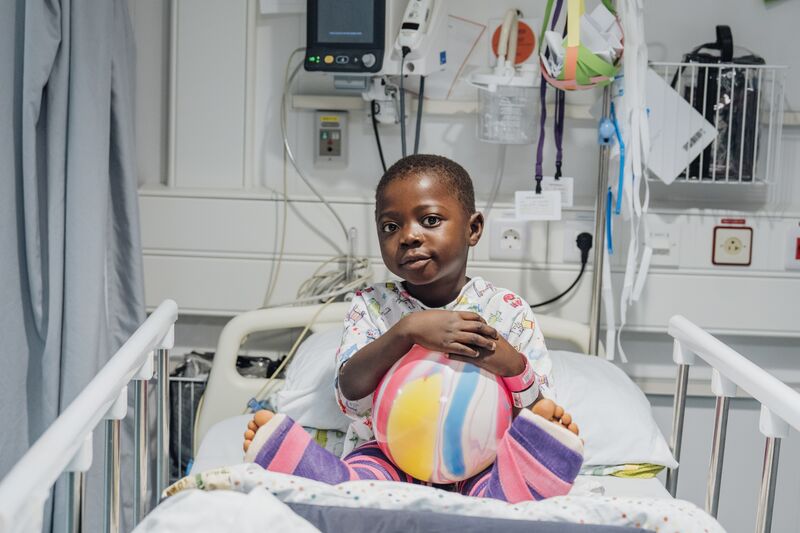
After surgery, Amara was placed in long leg casts and began the slow, steady process of rehabilitation. That’s when Emilia, a volunteer physical therapist from the UK, stepped in.
“When I first met him, he was sweet, quiet, and observant,” she said. “But you had to find what lit him up.” For Amara, that spark came through play, especially kicking a ball.
Emilia used creative therapy techniques to help Amara rebuild strength and movement: balloon games, puzzles, and, most importantly, the ball he loved. The goal was simple but vital: restore his mobility so he could rejoin his community.
“He had to learn to walk all over again,” Emilia explained. “But he has progressed fast.” She credits his rapid improvement to his thoughtful personality. “He watched everything going on in the room, and he really focused on his exercises. And I think that put him in good stead. He tried hard and always did what we asked him to do.”
Amara’s journey wasn’t just physical; it was also emotional. Years of bullying had left him hesitant about school and unsure of his place in the world. But as he grew stronger, so did his confidence.
“He has overcome so much and now he knows he can overcome hard things again,” said Emilia.
Dancing Into a New Future
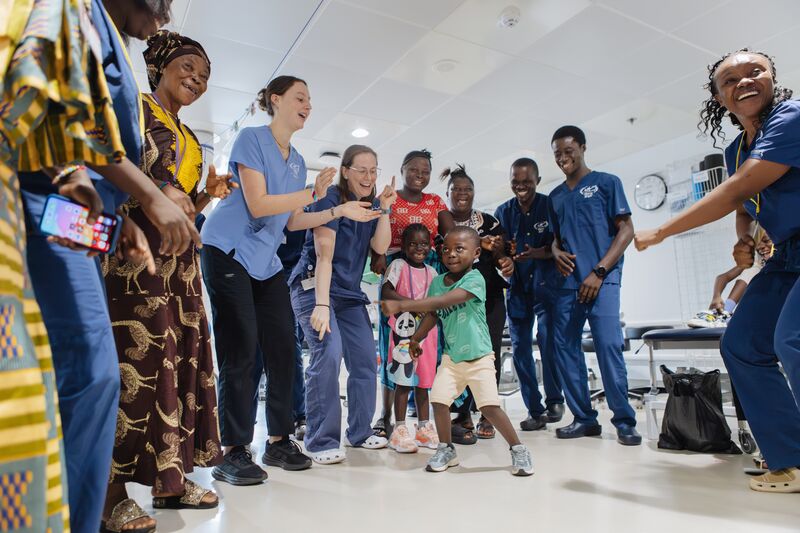
“At the end of every patient’s journey here, we do a discharge dance,” said Emilia. “And when the music started, I wasn’t even sure whether he would be willing to do the dance.”
But to her surprise, Amara said yes.
“He chose a song, we hit play, and he was rocking it! He was pulling some big moves, and I just couldn’t believe that this shy, quieter boy was suddenly in the middle of the circle. I’ll remember that for a long time!”
Today, Amara is back on his feet, his legs straight and his eyes a bit brighter. He walks with growing strength, and though the road ahead still holds challenges, he is no longer defined by his physical condition.
Alina, who donated blood for his surgery, was elated to visit him in his village and see him run with other kids and play football with a newfound strength in his legs. For Alina, it was an experience that she’d remember forever.
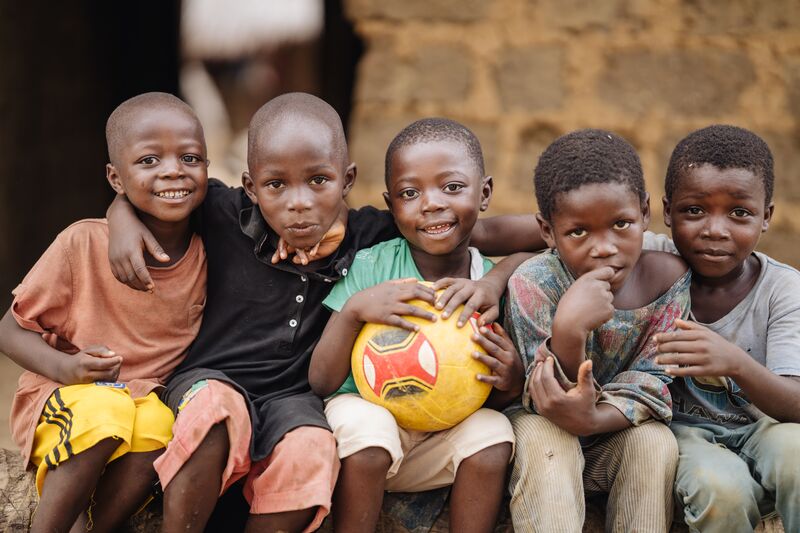
“It can be a really rewarding experience and very motivating as well,” she said. “I work in hospitality, and we sometimes forget we are even on a hospital ship. But just a few decks below, we can make connections with patients that remind us of what we’re actually doing and what impact all of this has.”
She was welcomed into Amara’s village alongside the Mercy Ships Communications team.
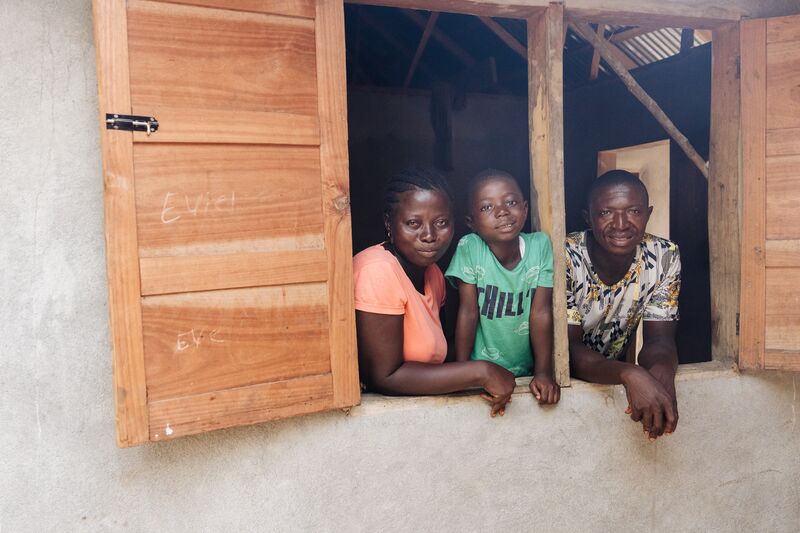
“I got to meet his extended family and the rest of his village. And it’s really nice to see where he’s actually from. To see where he’s going to grow up and where he might go to school,” Alina shared. “But what struck me coming to the village is just this warm welcome that we’ve received.”
Amara’s mother, who once felt helpless, now speaks with hope.
“I just want to say thank you to everyone who helped Amara,” she said. For Betty and her community, Amara’s healing is more than just physical. It’s a reminder that change is possible, even in the hardest of circumstances.
Dr. Carsi reflected on Amara’s transformation: “I would like to change the world, but I can’t. I can change one child at a time. That’s what we’re doing here.”
For Amara, that change has already begun.
Be a part of the next life-changing transformation! Visit mercyships.org and learn how your time, skills, or even a small donation can bring hope and healing to those waiting for a miracle.